

Keywords
syntagmatic
holistic comprehension
acqueline Hurtado de Barrera
holistics
research and methodology
science
How to Cite
Abstract
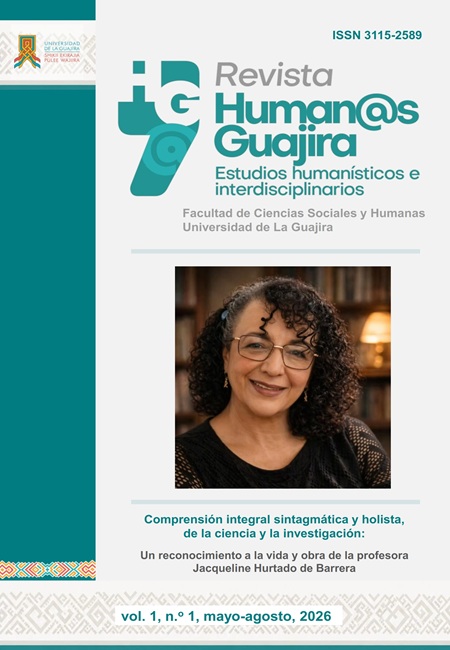
Intellectual training in science, research, and methodology has historically been shaped by diverse currents that have predominantly imposed a single way of conceiving and practicing science such as positivism, mechanistic thinking, physicalism, or realism, among others (Hurtado, 2012; Barrera, 2026). These perspectives have also consolidated a hegemonic operational and methodological model. Nevertheless, it is undeniable that science has produced extraordinary contributions, to the point of giving rise to multiple disciplines, professions, and fields of practice. This development deserves to be recognized and valued. However, the dominance of a single mode of thought has led to the subordination of other forms of knowledge production, which have had to adapt to or resist established frameworks. Despite this, alternative or peripheral approaches have achieved significant contributions. Within this context, the proposal of an integral, syntagmatic, and holistic understanding of science, developed by Professor Jacqueline Hurtado de Barrera, has made it possible to recognize the plurality of ways of doing science and has reaffirmed the logical and methodological processes involved in knowledge generation and in the culture of research. Likewise, theoretical, philosophical, and epistemological developments have been consolidated, strengthening a coherent structure for science and broadening the understanding of ways of thinking and researching, with an impact on academic formation. These advances are grounded in a holistic vision, in the “Eulerization” of scientific processes, and in a robust conceptual and methodological framework that enriches research practice. From this perspective, the authors present these reflections as academics interested in understanding science and contributing to research from their own professional practice.
References
Aristóteles (2014). Metafísica. Gredos.
Bacon, F. (1995). Teoría del cielo. Altaya.
Barrera Morales, M. F. (2026). Modelos epistémicos en educación e investigación. Ciea-Sypal.
Barrera Morales, M. F. (2013) Hologogía. Introducción a la educación holística. Quirón-Ciea-Sypal.
Barrera Morales, M. F. (2010a). Filosofía de la ciencia. Ciea-Sypal.
Barrera Morales, M.F. (2010b). Holística. Quirón.
Barrera Morales, M.F. (2010c). Modelos epistémicos en investigación y educación. Quirón.
Basarab, N. (1996). La transdisciplinariedad. Manifiesto. Multiversidad Mundo Real Edgar Morin, A.C.
Burgos, R., Burgos, F., Gilsanz Rodríguez, F., Téllez de Peralta, G. y Rodríguez Montes, J. A. (2021). Aristóteles: creador de la filosofía de la ciencia y del método científico. Portal Científico UAM. https://portalcientifico.uam.es/es/ipublic/item/8885133
Comte, A. (2017). Discurso sobre el espíritu positivo (J. Marías, Trad.). Alianza Editorial. (Obra original publicada en 1844).
Descartes, R. (2011). El discurso del método. Alianza.
Fals Borda, O. (2010). Antología. Editorial Universidad Nacional de Colombia
Freire, P. (1997). Pedagogía de la autonomía: Saberes necesarios para la práctica educativa. Siglo XXI.
González Rey, F. (2007). Investigación cualitativa y subjetividad. ODHAG.
Hurtado de Barrera, J. (2012). Metodología de la investigación: Guía para la comprensión holística de la ciencia. Quirón Ediciones.
Hurtado de Barrera, J. (2014). El proyecto de investigación. Quirón.
Hurtado de Barrera, J. (2020. Formulación de objetivos de investigación. Quirón. Sypal
Jiménez Garnica, E. (2026) Pensamiento filosófico de Karl Popper: El falsacionismo. Universidad Autónoma del Estado de Hidalgo. https://www.uaeh.edu.mx/scige/boletin/prepa3/n9/r1.html [consulta 20260419)
Kuhn, T. (1971). La estructura de las revoluciones científicas (A. Contín, Trad.). Fondo de Cultura Económica. (Obra original publicada en 1962).
Maturana, H. (1994). El árbol del conocimiento: las bases biológicas del entendimiento humano (19º. ed.). Editorial universitaria S.A. http://catedradatos.com.ar/media/maturana-arbol.pdf
Merleau-Ponty, M. (1993). Fenomenología de la percepción (J. Cabanes, Trad.). Planeta-Agostini. (Obra original publicada en 1945).
Morín, E. (1990). Introducción al pensamiento complejo. Gedisa.
Pichel Luck, M. (2025) El falsacionismo de Karl Popper. Universidad Nacional de La Plata. [Documento en línea: https://sedici.unlp.edu.ar/handle/10915/189371].
Popper, K. (1980). La lógica de la investigación científica (V. Sánchez de Zavala, Trad.). Editorial Tecnos. (Obra original publicada en 1934).
Prado Antúnez, A. (2024). Filosofía moderna: René Descartes y el método científico. https://goo.su/9wGfol
Solís Santos, C. (2013). La estructura de las revoluciones científicas 1922-1966. Fondo de Cultura Económica. https://goo.su/DyI0f

This work is licensed under a Creative Commons Attribution-NonCommercial-ShareAlike 4.0 International License.
Copyright (c) 2026 Araceli Pedroza Serrano, Francisco Sergio Díaz González