

Palabras clave
colonialidad algorítmica
inteligencia artificial
soberanía digital
justicia cognitiva
Cómo citar
Resumen
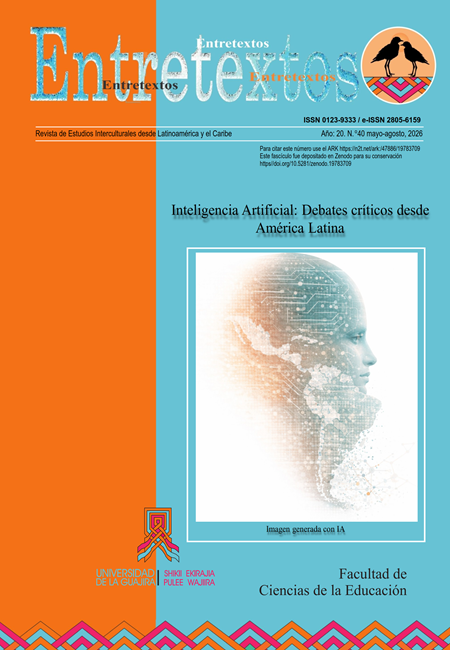
El artículo analiza el papel de los sistemas algorítmicos en la reconfiguración del capitalismo contemporáneo en América Latina, destacando su impacto en la distribución del poder, la producción de conocimiento y las nuevas formas de dependencia tecnológica. A partir de una revisión documental y un enfoque interdisciplinario que integra economía política digital, teoría de la dependencia y colonialidad del poder, se propone el concepto de colonialidad algorítmica para explicar la reproducción de jerarquías económicas, epistémicas y normativas mediante sistemas automatizados. El análisis, organizado en dimensiones infraestructural, epistémica y normativa, sostiene que estas arquitecturas refuerzan formas de subordinación digital, pero también abren posibilidades para estrategias orientadas a la soberanía tecnológica y la justicia cognitiva.
Citas
Acemoglu, D., & Restrepo, P. (2020). Robots and jobs: Evidence from US labor markets. Journal of Political Economy, 128(6), 2188–2244.
Amoore, L. (2020). Cloud ethics: Algorithms and the attributes of ourselves and others. Duke University Press.
Arriagada, A. (2020). Algorithmic cultures and the datafication of everyday life. Communication and Society, 33(3), 1–14.
Arrighi, G. (2007). Adam Smith in Beijing: Lineages of the twenty-first century. Verso.
Beer, D. (2017). The social power of algorithms. Information, Communication & Society, 20(1), 1–13.
Brynjolfsson, E., & McAfee, A. (2014). The second machine age: Work, progress, and prosperity in a time of brilliant technologies. W. W. Norton & Company.
Cardoso, F. H., & Faletto, E. (1969). Dependency and development in Latin America. XXI century.
Castells, M. (2010). The rise of the network society (2nd ed.). Wiley-Blackwell.
Couldry, N., & Mejias, U. (2019). The costs of connection: How data is colonizing human life and appropriating it for capitalism. Stanford University Press.
Couldry, N., & Yu, J. (2018). Deconstructing data colonialism. New Media & Society, 20(12), 4473–4491.
Eubanks, V. (2018). Automating inequality. St. Martin’s Press.
Frey, C. B., & Osborne, M. A. (2017). The future of employment. Technological Forecasting and Social Change, 114, 254–280.
Gillespie, T. (2014). The relevance of algorithms. In T. Gillespie, P. Boczkowski & K. Foot (Eds.), Media technologies (pp. 167–194). MIT Press.
Gonzales-Lara, J. Y. (2025). Deglobalization and reconfiguration of power in the contemporary world-system. Academia.edu.
Harvey, D. (2010). The enigma of capital and crises of capitalism. Oxford University Press.
Kitchin, R. (2017). Thinking critically about and researching algorithms. Information, Communication & Society, 20(1), 14–29.
Mignolo, W. (2011). The darker side of Western modernity. Duke University Press.
Milan, S., & Treré, E. (2019). Big data from the South(s). Television & New Media, 20(4), 319–335.
Morozov, E. (2019). ¿Digital socialism? New Left Review.
Noble, S. U. (2018). Algorithms of oppression. New York University Press.
O’Neil, C. (2016). Weapons of math destruction. Crown.
Pasquale, F. (2015). The black box society. Harvard University Press.
Quijano, A. (2000). Coloniality of power and social classification. Journal of World-Systems Research, 6(2), 342–386.
Santos, B. de Sousa. (2014). Epistemologies of the South. Paradigm Publishers.
Sassen, S. (2014). Expulsions. Harvard University Press.
Srnicek, N. (2018). Platform capitalism. Political Press.
Van Dijck, J., Poell, T., & De Waal, M. (2018). The platform society. Oxford University Press.
Varian, H. (2019). Artificial intelligence, economics, and industrial organization. Innovation Policy and the Economy, 19, 399–419.
Wallerstein, I. (2004). World-systems analysis. Duke University Press.
Zuboff, S. (2019). The age of surveillance capitalism. Public Affairs.

Esta obra está bajo una licencia internacional Creative Commons Atribución-NoComercial-SinDerivadas 4.0.