
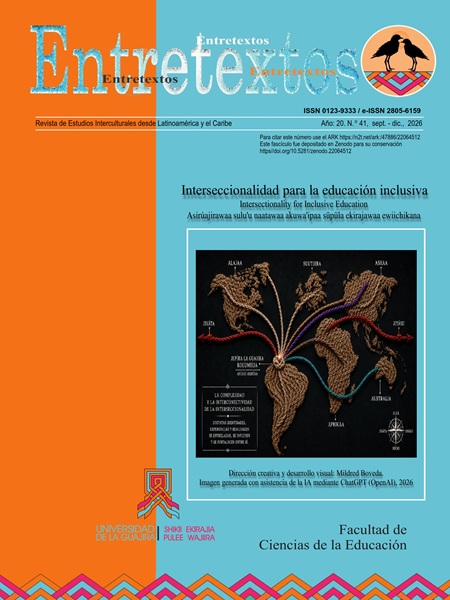
Intersectionality for Inclusive Education: Advancing Structural Perspectives Across the Educational Continuum
Editorial / Editorial / kashajalakaa


Editorial / Editorial / kashajalakaa
Inclusive education has become one of the defining commitments of educational policy and practice worldwide. International frameworks increasingly recognize education as a human right and emphasize the importance of ensuring that all learners have equitable opportunities. Yet the persistence of educational inequities reminds us that access alone does not guarantee inclusion (Boveda et al., 2026). Students continue to experience exclusion through the intersecting effects of disability, race, ethnicity, language, gender, social class, migration status, geographic location, and other dimensions of identity. These realities call for approaches capable of examining not only who is excluded, but also how educational systems themselves produce and sustain inequity.
Intersectionality provides one such approach. Since Kimberlé Crenshaw's (1989, 1991) foundational scholarship, intersectionality has become an influential framework for understanding how systems of power operate simultaneously rather than independently. Within educational research, scholars have argued that intersectionality expands analyses of equity by illuminating how institutional structures, policies, and practices shape learners' experiences across multiple dimensions of difference (Artiles, 2011; Collins & Bilge, 2020). Rather than treating disability, language, race, gender, or socioeconomic status as isolated variables, intersectionality invites educators to examine how these dimensions interact within broader systems of privilege and marginalization.
At the same time, inclusive education has undergone its own conceptual evolution. Once understood primarily as the placement of students with disabilities into general education settings, inclusion is now widely recognized as a broader project of educational transformation that seeks to redesign learning environments so that diversity becomes an ordinary and valued characteristic of educational communities (Florian, 2014; Waitoller & Kozleski, 2013). This shift aligns naturally with intersectional thinking because both perspectives challenge deficit-oriented assumptions and emphasize the importance of transforming institutions rather than expecting individuals to adapt to exclusionary structures.
This special issue emerged from a shared understanding that bringing these conversations together creates new possibilities for educational research and practice. The articles assembled here demonstrate that intersectionality is not simply another analytical framework to be added to inclusive education. Rather, it provides a means of reconsidering how educational systems understand difference, allocate opportunities, and imagine justice across diverse educational contexts. Collectively, the contributions illustrate that inclusive education is strengthened when examined through intersectional perspectives, while intersectionality itself gains new insights through engagement with educational practice.
To reflect both conceptual development and learners' educational trajectories, we have organized the articles across the educational continuum. Borges and Hudson challenge dominant assumptions about educational inequality by examining how intersectionality can reshape understandings of inclusion policies within Brazilian educational systems. Gilhuber and McGraw, situated in the Global North, examine the intersection of multilingualism and disability, arguing that inclusive education requires the coordinated delivery of linguistic and disability-related supports informed by perspectives from the Global South, as well as culturally responsive and contextually situated research. Morales, Bonivento Aguilar, & Ardila Santos further expand these conversations by proposing the Wayuu Circle of the Word as an intersectional and decolonial methodology that upholds Indigenous epistemologies and reimagines how educational knowledge is collaboratively produced. Together, these articles demonstrate that inclusive education requires critical engagement with the structures and knowledge systems through which educational inequalities are produced.
The second section turns attention toward inclusive educational experiences during children's formative years. Oliveira and Gediel use the case of Deaf students with multiple disabilities in Brazil to examine how deafness, multiple disabilities, language, and structural ableism intersect to shape inclusive educational practice in Brazil. Sánchez Moreno reconceptualizes school inclusion as educational continuity, demonstrating how intersecting territorial, social, and institutional conditions shape children's opportunities to participate, belong, and learn in rural post-conflict communities in Colombia. Together, these contributions illustrate that meaningful inclusion depends not only on access to schooling but also on educational environments that acknowledge the intersecting conditions shaping children's opportunities to participate, belong, and learn.
The third section focuses on teacher preparation and professional learning. Aborishade, Anokwuru, Myrie, and Oyefeso center the Nigerian context to examine teacher preparation through an intersectional lens, highlighting the knowledge and dispositions required for inclusive practice. Smigielski explores professional learning as an ongoing process of critical reflection that enables educators to respond thoughtfully to increasingly diverse learning communities. Together, these contributions demonstrate that inclusive education depends not only upon policy but also upon educators' capacity to critically engage with systems of inequity.
Questions of inclusion continue throughout postsecondary education and academic contexts in the fourth section, which focuses on higher education and research institutions. Drawing on interviews with women researchers from Uruguay and Argentina, historical analysis, and feminist genealogy, Correa García examines how capitalism, patriarchy, and coloniality shape the production of knowledge, arguing that intersecting systems of power continue to structure epistemic inequalities within academic and scientific institutions. Contreras Aguirre and Long, situated at a Hispanic-Serving community college in the United States, examine institutional practices that foster equitable participation through inclusive pedagogy. Gibson, Morgan, Anderson, and Williams-Nettles extend these conversations by examining peer mentoring and disability justice at a Historically Black College and University (HBCU), illustrating how universities can cultivate educational environments that affirm learner diversity and foster meaningful belonging. Collectively, these articles highlight both the opportunities and continuing challenges associated with creating more inclusive institutions of higher education.
The final articles look beyond the school classroom through examinations of community, labor, and transformative partnerships, broadening the conversation beyond formal educational institutions. Robertson and Quintana Pacheco draw on a partnership between a Salvadoran maquila workers' association and a U.S. university to illustrate how popular education and community engagement can foster more equitable educational relationships. Aguirre-Ortega and Ortega Verbel examine intergenerational dialogues with/within Afro-Colombian communities, demonstrating how territory, memory, and collective knowledge shape intersectional understandings of inclusion beyond institutional settings. Together, these concluding contributions reinforce the idea that inclusive education is fundamentally relational, extending across schools, universities, families, workplaces, and communities.
Although the articles address diverse educational settings and national contexts, several common themes emerge across the collection. To begin, the authors consistently reject deficit-based understandings of difference, instead positioning diversity as a resource for educational transformation. Moreover, the contributions demonstrate that educational inequities are structural rather than individual, requiring attention to institutional cultures, policies, professional preparation, and community relationships. Finally, the collection of articles illustrate that intersectionality is not limited to analyses of personal identity; it also provides a powerful framework for examining curriculum, teacher education, leadership, higher education, educational policy, and community engagement.
Collectively, these articles reflect the growing international/transnational character of scholarship on inclusive education. The authors draw upon experiences from multiple countries and educational traditions, demonstrating that while educational systems differ considerably, many confront similar questions concerning equity, participation, recognition, and justice. Rather than seeking universal solutions, the special issue encourages dialogue across contexts while respecting the historical, cultural, linguistic, and political conditions that shape educational practice.
As guest editors, we hope this collection contributes to ongoing conversations about the future of inclusive education. The articles assembled here suggest that achieving inclusion requires more than expanding access or improving instructional strategies. It requires rethinking the assumptions that organize educational systems, whose knowledges are recognized and respected. Intersectionality offers an important framework for undertaking this work because it reminds us that educational inequities emerge through interconnected systems rather than isolated categories of difference.
Ultimately, this special issue invites readers to view inclusive education not as a finished project but as an ongoing process of institutional and social transformation. By bringing together scholars working across diverse contexts, disciplines, and educational levels, the dossier demonstrates that educational justice is strengthened when intersectionality and inclusive education are understood as mutually informing frameworks. It is our intention that these contributions inspire continued dialogue, critical inquiry, and collaborative action toward intersectionally conscious educational systems.
Declaraciones
Conflicts of Interest
The authors declare no conflict of interest.
Data Availability Statement
Not applicable.
Biodata
Doctora en Educación para Estudiantes Excepcionales, en Florida International University, Maestría en Políticas y Gestión Educativa en Harvard Graduate School of Education. Profesora de Educación Especial en Erikson Institute (Estados Unidos). Su investigación se centra en la educación inclusiva, la formación del profesorado, la interseccionalidad, la justicia de la discapacidad y la equidad educativa. Es reconocida por desarrollar los conceptos de intersectional competence e intersectional consciousness, que han contribuido al análisis de las múltiples identidades que configuran las experiencias educativas y a la preparación docente para contextos diversos. Coeditora de Review of Educational Research. Ha ocupado cargos de liderazgo en la American Educational Research Association (AERA) y el Council for Exceptional Children (CEC).
Estadísticas internas
Este recurso propone una orientación y clasificación superficial de los recursos documentales utilizados por el artículo. Permite a los equipos editoriales conocer el comportamiento documental de sus artículos y a las personas autoras reconocer las tipologías que sustentan la investigación.
Estadísticas automáticas derivadas del marcado interno del XML-JATS. No son métricas de impacto. Lea estas estadísticas con prudencia porque la automatización puede provocar errores o no contemplar al 100 % la realidad de esta publicación.
Transparencia y buenas prácticas
Su propósito es promover una mejora en las prácticas de marcado de los artículos de las revistas científicas y motivar una preocupación cada vez más exhaustiva por el cumplimiento de las mejores prácticas editoriales.
Indicadores extraídos automáticamente desde el XML-JATS (heurísticos) que funcionan como base para sostener mejores prácticas. No omita que siempre la revisión y confirmación debe ser humana. Use estos indicadores como señales y no como evaluaciones.
- Todos los autores tienen filiación Sí
- Hay identificador persistente del artículo (p. ej., DOI/ARK) Sí
- Se declaran fechas de recepción y aceptación No
- Se declara licencia de publicación Sí