
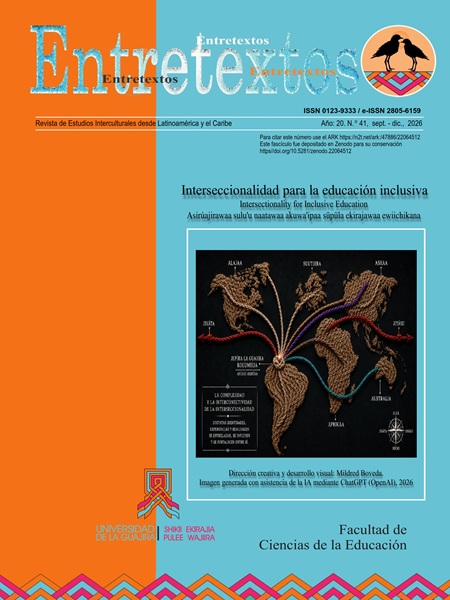
Intersectionality and inclusive education: a shared commitment across contexts
Perfiles/Profiles/Anüliama'a


Perfiles/Profiles/Anüliama'a
Our paths to this special issue began in different places, shaped by distinct professional experiences, academic traditions, and cultural contexts. One of us—Mildred Boveda—has worked primarily in the United States, examining inclusive education through the lenses of intersectionality, disability studies, multilingualism, and teacher preparation. The other— Alba Ruth Pinto Santos— has dedicated her career to teacher education, educational innovation, and intercultural research in Colombia, particularly in La Guajira, a region whose cultural, linguistic, and geographic diversity continually challenges educators to rethink conventional approaches to teaching and learning.
Although our work has developed in different settings, we have long shared a common question: How can educational systems become truly inclusive if they fail to recognize the complex realities that shape learners' lives? This question ultimately brought us together as collaborators and inspired the development of this special issue.
Throughout our careers, we have witnessed educational institutions committed to inclusion while simultaneously reproducing exclusion. Policies often celebrate diversity, yet students continue to encounter barriers associated with disability, race, ethnicity, language, gender, social class, migration, geography, and other dimensions of identity. Too often, these realities are addressed separately, as though they exist independently of one another. Our experiences as researchers, teacher educators, and collaborators have reinforced the importance of understanding these dimensions as interconnected rather than isolated.
Intersectionality provides a valuable way of thinking about these complexities. For us, however, it is more than a theoretical framework. It is a way of asking better questions about education. It encourages us to look beyond individual characteristics and consider the institutional, historical, and social conditions that shape educational opportunity. At the same time, our work also indicates that intersectionality is most meaningful when it remains connected to practice. That is, intersectionality must inform how teachers are prepared, educators engage with communities, and educational systems respond to the diversity of learners they serve.
Our collaboration has also been shaped by dialogue across languages and academic traditions. Working together has reminded us that educational knowledge is enriched when scholars bring different perspectives into conversation rather than assuming that one context offers universal solutions. The partnership between a scholar based in the United States and a scholar rooted in the Colombian Caribbean reflects the broader aspirations of this dossier: to foster dialogue across nations while remaining attentive to the particular histories, cultures, and communities that shape educational experiences.
As guest editors, we envisioned this special issue as a space where these conversations could flourish. We hoped to bring together contributions that would examine inclusive education from multiple perspectives while remaining connected by a shared commitment to educational justice. The response exceeded our expectations. In fact, this is the first of two volumes that will result from our initial call. The manuscripts we received represent diverse countries, educational levels, disciplinary traditions, and methodological approaches, yet they share a common concern with understanding how systems of inequality influence opportunities to learn, teach, and participate.
One of the most rewarding aspects of editing this special issue has been discovering the many ways scholars are extending conversations about intersectionality and inclusive education. Rather than applying a single model or perspective, the authors engage with local realities, community knowledge, Indigenous methodologies, teacher preparation, multilingualism, disability, higher education, rural schooling, and popular education. Together, they demonstrate that meaningful inclusion requires attention not only to learners but also to the institutions, policies, and relationships that shape educational life.
The editorial process also reminded us that inclusive education is fundamentally collaborative. Researchers, teachers, families, community leaders, and policymakers each contribute different forms of knowledge to the work of educational transformation. No single discipline, methodology, or national context can fully explain the complexities of educational inequity. This understanding is particularly important at a moment when educational systems around the world are facing questions of equity, belonging, cultural recognition, technological change, migration, and social justice. Responding to these challenges requires critical reflection, and a commitment to understanding how structures of power influence educational opportunity across diverse contexts.
We hope readers will approach this first volume special issue with both curiosity and openness. While each article addresses a distinct aspect of inclusive education, together they offer a broader invitation to reconsider how educational systems can become more responsive to the complexity of human experience. We also hope the collection encourages new conversations among researchers, educators, students, and communities who share a commitment to educational equity.
Finally, this special issue reflects the value of collaboration itself. Our partnership has demonstrated that meaningful scholarship grows through dialogue—across countries, languages, disciplines, and lived experiences. Although we began this project from different positionalities, we found common purpose in creating a space where diverse perspectives could inform one another in the pursuit of more just and inclusive educational systems.
We are grateful to the authors, situated across five different continents, who entrusted us with their work, to the reviewers whose thoughtful feedback strengthened every contribution, and to the editorial team of ENTRETEXTOS for supporting a dossier that brings together voices from multiple regions and intellectual traditions. We also would like to acknowledge Francisca Figueroa whose provocations and compilation of a bibliography of readings on intersectionality beyond the United States have been an important guide throughout this process. It is our hope that the conversations initiated in these pages will continue to inspire research, professional learning, and collaborative action toward educational systems in which every learner is able to disrupt marginalization and intersecting oppressions.
Declaraciones
Conflicts of Interest
The authors declare no conflict of interest.
Data Availability Statement
Not applicable.
Biodata
Doctora en Educación para Estudiantes Excepcionales, en Florida International University, Maestría en Políticas y Gestión Educativa en Harvard Graduate School of Education. Profesora de Educación Especial en Erikson Institute (Estados Unidos). Su investigación se centra en la educación inclusiva, la formación del profesorado, la interseccionalidad, la justicia de la discapacidad y la equidad educativa. Es reconocida por desarrollar los conceptos de intersectional competence e intersectional consciousness, que han contribuido al análisis de las múltiples identidades que configuran las experiencias educativas y a la preparación docente para contextos diversos. Coeditora de Review of Educational Research. Ha ocupado cargos de liderazgo en la American Educational Research Association (AERA) y el Council for Exceptional Children (CEC).
Doctora en Tecnología Educativa, con maestrías en Tecnología Educativa y en Medios Innovadores en Educación. Profesora Titular, Facultad de Ciencias de la Educación, Universidad de La Guajira, Colombia. Orienta asignaturas del campo de formación en investigación, en pregrado y posgrado. Su trabajo investigativo se sitúa en la intersección entre tecnología educativa, pedagogía, innovación curricular y educación intercultural, con especial interés en contextos territoriales diversos, particularmente en comunidades indígenas. Grupo de investigación INECTIC. Investigadora Senior reconocida por Minciencias.
Estadísticas internas
Este recurso propone una orientación y clasificación superficial de los recursos documentales utilizados por el artículo. Permite a los equipos editoriales conocer el comportamiento documental de sus artículos y a las personas autoras reconocer las tipologías que sustentan la investigación.
Estadísticas automáticas derivadas del marcado interno del XML-JATS. No son métricas de impacto. Lea estas estadísticas con prudencia porque la automatización puede provocar errores o no contemplar al 100 % la realidad de esta publicación.
Transparencia y buenas prácticas
Su propósito es promover una mejora en las prácticas de marcado de los artículos de las revistas científicas y motivar una preocupación cada vez más exhaustiva por el cumplimiento de las mejores prácticas editoriales.
Indicadores extraídos automáticamente desde el XML-JATS (heurísticos) que funcionan como base para sostener mejores prácticas. No omita que siempre la revisión y confirmación debe ser humana. Use estos indicadores como señales y no como evaluaciones.
- Todos los autores tienen filiación Sí
- Hay identificador persistente del artículo (p. ej., DOI/ARK) Sí
- Se declaran fechas de recepción y aceptación No
- Se declara licencia de publicación Sí